 Cravenpod
/ Long-form Fulham
Cravenpod
/ Long-form Fulham
Cravenpod
/ Long-form Fulham
Cravenpod
/ Long-form Fulham
Four seasons at Fulham. A composite model weighted for recency. The worst PSxG–GA in the Premier League this season. A goalkeeper, and a question, that the numbers will not let us look away from.
20 May 2026 · Cravenpod · ~12 min read
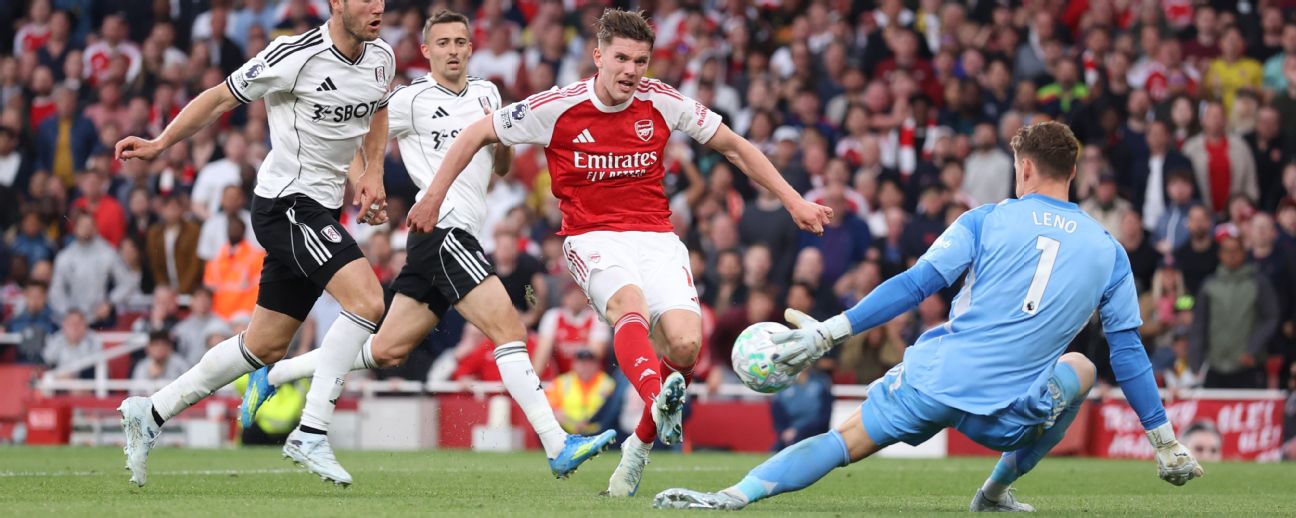
Bernd Leno arrived at Fulham in August 2022 on a three-year deal from Arsenal and was, almost immediately, very good. He played 37 of 38 league games in his first season, finished the year with the best post-shot expected goals minus goals against figure in the Premier League, and steered a newly-promoted side to a tenth-place finish that nobody had really seen coming. That was nearly four years ago. He is still our number one. Whether he should be is the question this piece exists to answer.
This is the first instalment of an ongoing series taking each position in the Fulham squad in turn, building a composite model of recent form, and asking the same question every time: is the player Marco Silva keeps picking still the right one? We are starting with the goalkeeper because that is where the numbers, as of mid-May 2026, are loudest.
What follows is a deliberately quantitative look. There is a stat-stack, there is a Chart.js line, there is a peer benchmark, and there is a method box you can skip if formulas are not your thing. But the conclusion is not really a formula. It is a trajectory. And the trajectory, on every measure that adjusts for the work in front of him, has been pointing down for three seasons.
Start with the simplest, hardest fact we have. Post-shot expected goals minus goals against — PSxG–GA, the shot-stopping metric most analysts default to because it asks only the goalkeeper's question: given the shots you faced, after they left the foot or head, how many did you save versus the league-average keeper? Positive is good. Negative is bad. Across the 2025/26 Premier League season, the keeper at the bottom of the table is Bernd Leno, at −6.30. That is not just the worst figure of the four full seasons he has played at Fulham. It is the worst figure in the league this year, full stop.
To put a frame on that number: a PSxG–GA of −6.30 means that the model expected a league-average goalkeeper, facing the exact shots Leno faced this season, to have conceded roughly six and a third fewer goals than he actually did. That is, very loosely, two league points. Possibly three.
Leno's raw goals-against-per-90 in 2025/26 is 1.35 — the lowest of any of his four Fulham seasons. The team is conceding fewer, easier shots. He is still letting in more of them than the model says he should. The "his stats look fine because Fulham defend better" reading is exactly wrong: the model adjusts for shot quality and says he is underperforming the easier workload.
This is the kind of regression that sneaks through traditional eye-test review of a goalkeeper, because the shape of the game in front of him has changed. Fewer high-quality chances. Lower xG conceded per match. Three years ago Leno was making the impossible save in a defence that gave up the ball at the edge of the area. This season he is letting in the saveable one in a defence that mostly does not give it up at all. The fan watching at Craven Cottage sees the second of those scorelines. The model sees both.
One season is a sample. Four seasons is a career. The problem with looking at a career number is that it flattens everything: a brilliant 2022/23 lifts a terrible 2025/26 into something that looks tolerable, even though no Fulham fan can watch the keeper today and call it tolerable. The fix is exponential decay — weight recent seasons more heavily than old ones, and let the composite tell you where the player actually is, not where they used to be.
| Season | Raw weight (λ^k) | Normalised % | |
|---|---|---|---|
| 2025/26 | 1.000 | 39.5% | |
| 2024/25 | 0.700 | 27.6% | |
| 2023/24 | 0.490 | 19.3% | |
| 2022/23 | 0.343 | 13.5% |
Run that math on Leno's four Fulham seasons and the composite lands in the bottom quartile of the 20-team peer group, and at the bottom of the 7th–16th subset — the table position cluster Fulham actually compete inside. Strip the decay out and use only 2025/26, and he is at the very bottom of the league. The weighting smooths but does not reverse the conclusion. If anything, the model is being generous: 60.5% of his composite score still comes from the three previous seasons.
Plot PSxG–GA across his four seasons and the shape is almost embarrassingly clean. A 99th-percentile peak in year one. A small loss in year two. A larger loss in year three. A deep loss in year four that is now the worst tail observation in the league. The slope has not just been downward — the rate of decline has been accelerating.
The most useful framing I have for this comes from the trading desk rather than the touchline. Treat each goalkeeper as a position. Treat the decayed composite as a mark-to-market PnL. What you have on Leno is a three-year drawdown, with the largest single-period loss in the most recent period, and a tail observation that is the worst in the cohort. That is not a player going through a rough patch. That is a regression that is not stabilising.
There is also a club-internal datapoint worth noting in passing. Leno's 2024/25 ledger included two errors directly leading to a goal — the worst of his four-year career here. That is a small-sample stat by itself, but it lines up with the same direction of travel the composite is picking up. The model is not seeing something the eye is missing. It is just measuring it.
The composite gets the most useful when you put Leno side by side with the rest of the league's number ones. The chart below ranks the first-choice Premier League goalkeepers on the same single metric we have been using throughout — PSxG–GA for 2025/26. The mid-line is the league-average bar. Anything to the right of it is a goalkeeper who saved more than expected. Anything to the left is a goalkeeper who let in more than the shots predicted.
It is the gap that tells the story. There are three or four other keepers in negative territory this season. Leno is roughly double the next-worst figure. That is not a "needs a clean sheet to climb the table" position. That is a "the rest of the cohort is sitting in front of you and you are still meaningfully behind them" position.
"The shape of the game in front of him has changed. Fewer high-quality chances. Lower xG conceded per match. He is still letting in more of them than the model says he should."
From § 02 above — worth re-readingA model that produces a tidy answer is a model worth pressure-testing. Three things to keep in mind before anyone takes this piece to the comment thread.
One — the decay parameter is a choice. λ = 0.7 gives a roughly two-season half-life, which is defensible for goalkeepers but not the only defensible setting. Steeper decay (λ = 0.5, newest season ~53% weight, half-life ~1 season) drops Leno's composite further. Flatter (λ = 0.85, newest season ~31%, half-life ~4 seasons) lifts it modestly. Even at the gentlest, he still lands bottom-quartile. The conclusion is robust to the choice. Worth saying that out loud.
Two — the 2025/26 figures are a mid-late season snapshot. The peer comparison uses the latest published league-wide dataset (FotMob, late February 2026). End-of-season figures will move. They will not move by ten goals.
Three — save percentage for the peer set is approximated where the exact figure was not cleanly sourced. Since PSxG–GA does most of the statistical work in the composite and is calculated from public shot data, the conclusion is reasonably robust to that approximation. But if you are reading this and you have access to an end-of-season FBref pull, I would love to see a re-run.
What is not a caveat: the direction. Across every reasonable parameter, every sub-metric, and every peer comparison I can build, Leno's trajectory at Fulham points the same way, and the gap to the rest of the cohort widens in the most recent year.
This piece does not say sell him in June. It does not say Benda is ready. It does not say there is a goalkeeper available on a free who would fix it. Those are different questions, each with their own model, and each will get their own instalment in this series.
What this piece does say is: the case for Bernd Leno being our undisputed first-choice goalkeeper for the 2026/27 season cannot be built on his performance over the last three years. If the case exists, it has to be built on something else — leadership, build-up, the cost of an alternative, or a coaching belief that 2025/26 was a single bad season inside an otherwise stable profile. The shot-stopping data does not support the last of those. The other three are not statistical arguments. They are footballing ones, and they are the conversation Marco Silva and Tony Khan will be having between now and August.
For now, the file on the goalkeeper position is open. Part 2 is being scoped already.